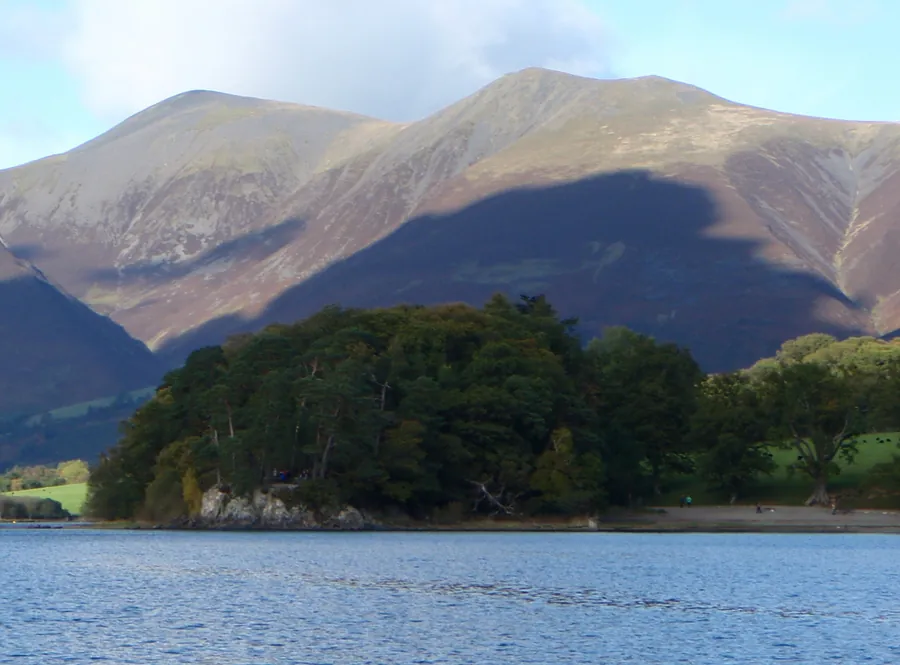
Friars Crag is a wooded promontory jutting into Derwentwater, about 1.2 kilometres from the middle of Keswick along the lake shore.
It is the most-walked path in the northern Lakes and it deserves to be. The walk is flat, surfaced and short — fifteen to twenty minutes from the town centre — and it ends at a view that has been famous for two hundred years: straight down the length of Derwentwater to the Jaws of Borrowdale, with the fells closing in on both sides and the lake islands in the foreground.
John Ruskin was brought here as a small child and later wrote that the memory of standing on the roots of the trees at Friars Crag was one of the three or four most important scenes of his life. He is usually quoted as ranking the view among the finest in Europe.
There is a memorial to him at the crag, set up in 1900, and the association is the reason the place became a fixture of the Victorian tour.
Friars Crag matters to conservation history as well as to landscape.
Canon Hardwicke Rawnsley, vicar of Crosthwaite in Keswick, was one of the three founders of the National Trust in 1895 — alongside Octavia Hill and Robert Hunter — and much of the impulse came from fights over access and development around Derwentwater.
Friars Crag and the Derwentwater foreshore were among the Trust’s earliest acquisitions, bought for the public in the 1920s as a memorial to Rawnsley. There is a memorial to him here too.
The tradition is that the crag was the point from which medieval pilgrims embarked for St Herbert’s Island in the lake, where the seventh-century hermit St Herbert — a friend of St Cuthbert — had his cell. The island is visible from the crag.
From Keswick town centre, down Lake Road past Hope Park, to the Theatre by the Lake and the boat landings, then along the shore path through trees to the crag.
It is level and largely surfaced, suitable for pushchairs and, for most of its length, for wheelchairs — one of very few genuinely accessible lake views in the district. The last few metres onto the crag itself are rockier.
You can continue beyond the crag along the shore towards Calfclose Bay and the Centenary Stone, or make a longer circuit round the lake.
There is a bench at the viewpoint and it is, by universal report, occupied. Visitors queue for it, and there are complaints about people settling in with a picnic for an hour.
The practical answer is that the view is the same standing up, and there is more room a few metres either side.
People swim from the shore below, and the water is clean and cold. Be warned that the rocks in the shallows are sharp — swimmers mention it consistently. Bring something on your feet.
Free, open at all times. National Trust land; car parking is charged at Lakeside, free to members, or walk from the town.
Time: forty minutes return from Keswick, plus time at the crag.
Facilities: toilets, café and the theatre at the boat landings on the way.
Boats: the Keswick Launch calls at Lakeside and circles Derwentwater with seven stops — an excellent way to combine the walk with a boat.
Best time: early morning for stillness and reflections; late autumn for colour and few people.
About 1.2 kilometres, fifteen to twenty minutes on a level path.
Largely — the path is level and surfaced and works for pushchairs and most wheelchairs, though the final rocky section onto the crag is harder.
For the view down Derwentwater to Borrowdale, celebrated by Ruskin, and as one of the National Trust’s earliest acquisitions.
Charged National Trust parking at Lakeside, free to members. Most people walk from the town.
Yes, from the shore below, but the rocks in the shallows are sharp — wear something on your feet.