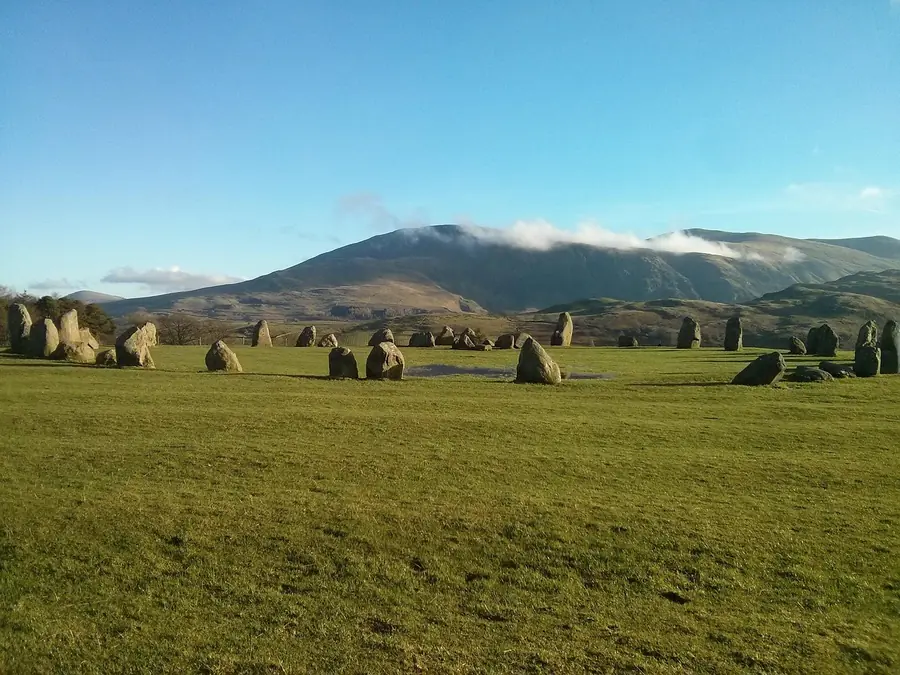
Castlerigg stands on a low hill two and a half kilometres east of Keswick, and it is one of the earliest stone circles in Britain — probably raised around 3200 BC, in the early Neolithic, which makes it older than Stonehenge in its finished form and older than the pyramids.
It has 38 stones in a flattened circle about 30 metres across, with an unusual rectangular setting of ten stones — the Sanctuary — inside the eastern side, found at no other circle.
The stones are not what makes Castlerigg extraordinary. The position is.
The circle sits on a natural plateau ringed by fells on every side: Skiddaw and Blencathra to the north, Helvellyn to the east, the Borrowdale fells and Causey Pike to the south and west. The horizon is mountain the whole way round, and the circle sits in the middle of it like the centre of a bowl.
Whoever chose the site chose it for exactly that, and the effect is undiminished 5,000 years later. There are alignments — the tallest stones, midwinter sunrise, notches in the surrounding skyline — argued over by archaeoastronomers with varying degrees of confidence, but the plain fact of a monument built to sit inside a ring of mountains needs no theory.
The stones are Borrowdale volcanic rock, glacial erratics gathered from the valley rather than quarried.
Because it is completely open. No fence, no ticket, no visitor centre, no roped path. You walk in among the stones and touch them, at any hour, in any weather, for nothing. English Heritage and the National Trust look after it between them and have had the good sense to leave it alone.
That openness is also the source of the one recurring complaint. On a fine summer evening Castlerigg can feel less like an ancient monument and more like a public park — picnic blankets, groups, drone noise, people queuing for photographs. Visitors expecting solitude and finding a crowd say so with some feeling.
The answer is timing. Go at dawn, or in winter, or in weather that keeps people away. At seven on a January morning with frost on the stones and the fells white, it is one of the most powerful places in England.
Free, open at all times, all year.
Parking: a small layby on Castle Lane, free, holding perhaps a dozen cars. It fills. The lane is narrow.
Walking from Keswick: about 45 minutes each way, uphill, on a signed route via Springs Road and the fields — a good walk in its own right and the way to avoid the parking problem entirely.
Time: twenty minutes to an hour.
Facilities: none whatever. No toilets, no bins, no shelter.
Underfoot: grass field, often wet, with a gate. It is level once you are in.
Livestock: the field is grazed. Dogs on leads.
Threlkeld Quarry and Mining Museum is four kilometres east.
Keswick is the other way, with Derwentwater below it.
Blencathra rises directly north and is one of the best fells in the Lakes.
Probably around 3200 BC — one of the earliest stone circles in Britain, and older than the standing stones at Stonehenge.
Yes, entirely, and open at all hours with no fence or ticket.
A small free layby on Castle Lane holding about a dozen cars, on a narrow road. It fills quickly.
Yes, about 45 minutes each way on a signed uphill route — the better option in season.
Early morning, winter, or poor weather. On fine summer evenings it can be very busy.